“To arrive at any given point in the future …”
essay published in Future Book(s). Edited by Pia Pol und Astrid Vorstermans. Valiz, 2023.
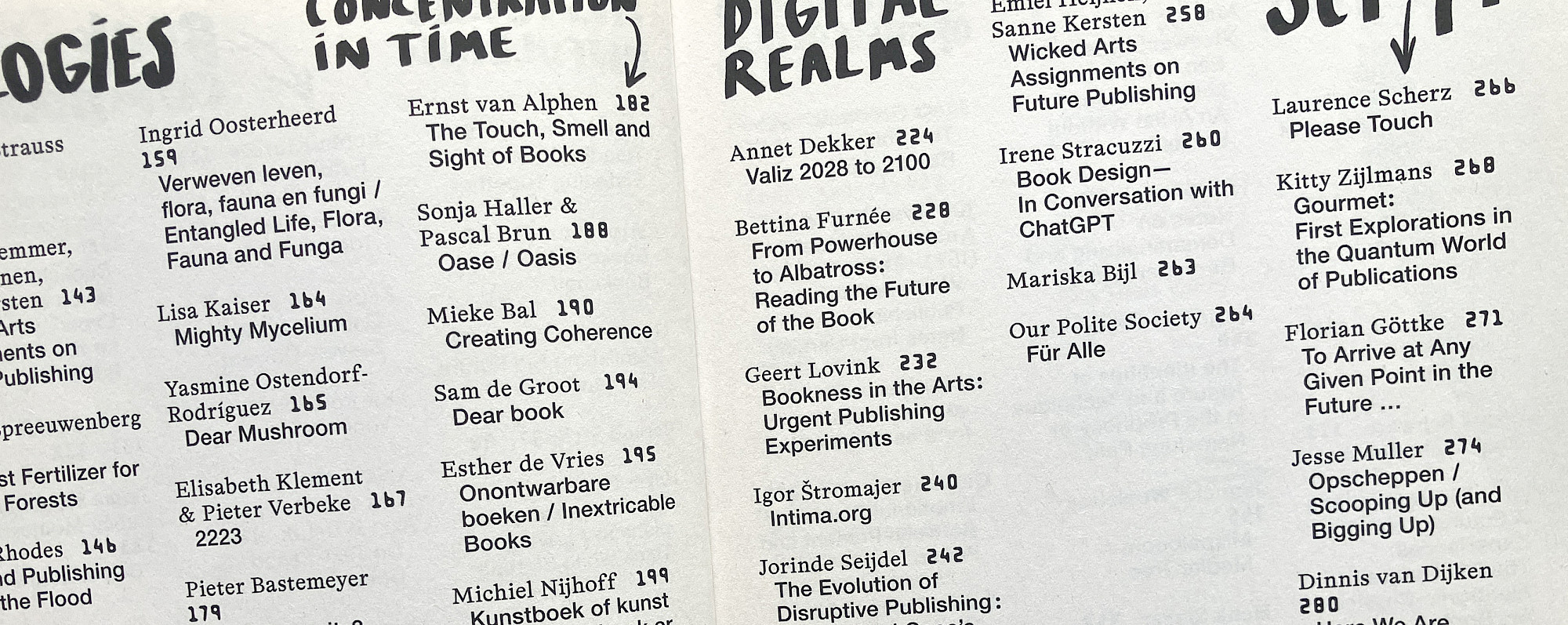
To arrive at any given point in the future …
. . . desirable or not from a human perspective, would require to trace the movement of every object, every person, every organism, every molecule, every atomic- and sub-atomic particle, as well as the planets and galaxies in this universe back to this moment in the present. A fundamentally impossible task, no matter if this point in time would be five seconds or five billion years from now.
It might actually be easier to predict the state of our planet five billion years from now, when in a different quadrant of the galaxy it will still move around the sun, largely undisturbed by the slow and majestic collision of our Milky Way Galaxy with the neighbouring Andromeda Galaxy, drawn out over billions of years. By then the sun will have so far increased in luminescence that the Earth’s oceans have evaporated and it’s surface consists of one big turbulent ocean of molten lava. The eight billion individuals of the species homo sapiens that currently live on Earth will have long perished, their bones turned to dust, even their molecules reconfigured over and over again. But the atoms and the myriad subatomic particles they consisted of are continuing their constant vibrant dance, attracting and repelling each other, absorbing energy, emitting radiation, jumping orbits, spinning, stringing along, fluctuating from one ghostly, strange and charming state to another.
Nearer in time, in five million years, Earth might much look like it did five million years ago. It is unlikely that humans as a species will have survived the catastrophic planetary events, such as changes in the magnetosphere, super vulcanoes, or meteorites crushing into Earth, which for sure will have happened in the meantime. Planetary life, though, will have recovered from these catastrophes as well as from the current human-induced mass extinction. Earth will again be covered by vast forests, deserts, wetlands and swamps, thriving with live. Many new species will roam the continents and fill the waters. Even in this rather short geological time frame, the impact of human life on earth will most likely be limited.
In the next five thousand years, though, it is very unlikely that a catastrophic planetary event will occur and wipe out humankind completely. Much more likely, humans still exist, but in what numbers, with what level of technology, and in what kind of societies, is quite impossible to predict. The biggest dangers will be our self-made environmental and civilization-wide crises, which have already resulted in a diminished and depleted habitat, in decreased fertility, in pandemics, and a steep increase in chronic illnesses. These challenges will only get worse.
The countless science fiction books and films imagine the many variations where we can go wrong and end up as a doomed and debased, apocalyptic, oppressive, zombified humankind, driven by the lowest human impulses. Easy solutions to humankind’s problems, such as the invention of a source of clean and limitless energy, the escape to other worlds, or a sudden jump in human consciousness that will thoroughly change our egocentric impulses, will remain elusive. Life will always be messy, but hopefully we will develop a more sustainable way of living, and manage to exist in a more stabilised relationship with our companion species in the planetary biosphere.
Five years ahead on the other hand is a span of time comprehensible to human imagination, where the decisions made in the present, will have tangible consequences. To imagine and work towards a viable future means not counting on the catastrophe and descending into dystopian nihilism, but to take into account the catastrophic consequences of irresponsible extractivist human behavior. I hope to stand with my partner and my daughter on the property that we will have bought with group of like-minded people in an attempt to build an alternative community and practice a more sustainable way of living. A place where we could grow much of our own food, generate an excess of energy from renewable sources. It would be a community not in isolation but in exchange with communities closer and farther away, that serves the needs of people in different situations and life stages.
But even the moment ahead in time, as I am lying in the dark imagining the future, the quiet rhythm of my partner’s breathing beside me . . . when a sound in our apartment, a creaking of the floor, caused by the light footsteps of our daughter, will catch my attention, and I will turn my head to listen for just a fraction of time . . . to pause, in a suspended moment of timelessness that stretches the universe to all sides . . . when I will get a sense of vertigo from the quiet awareness of the countless possible futures lying ahead . . . until the moment will have passed . . . even that moment ahead in time is impossible to predict.